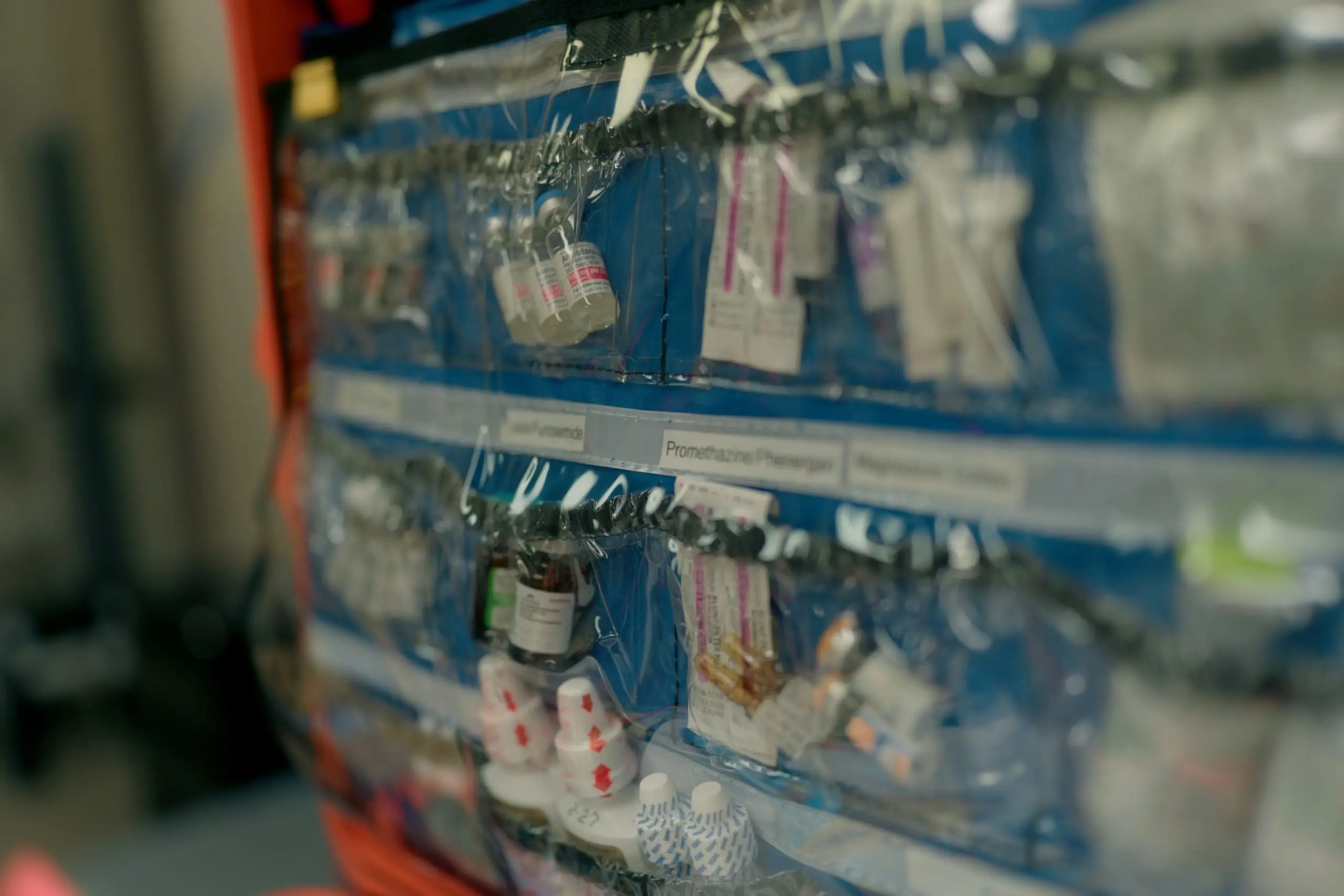
medical_information
Initial outfitting to a defined standard
Built from asset type, crew size, scope of care, distance to shore, and the regulatory environment — not from a catalogue package.

An auditor has never opened a sick bay and asked whether you have morphine. They ask to see every dose, who signed for it, and where the balance went — and under 21 CFR 1304 that record has to exist aboard the asset. An expired vial is a housekeeping problem; an unaccounted controlled substance is a diversion finding.
Sick bay outfitting and medical supply management for offshore platforms and vessels is only partly a procurement problem. The exposure sits in custody, expiry, and reconciliation — the parts nobody owns until an inspection finds they were never owned.
Controlled substances supplied to a shipboard medicine chest are documented in triplicate — one copy retained aboard, one to the DEA Division Office within fifteen days of month-end.
OSHA requires adequate first-aid supplies to be readily available. An expired item, a depleted kit, or a locker nobody has opened in a year does not meet that standard.
The ocean-vessel controlled-substance provisions went essentially unchanged for five decades. DEA moved to tighten accountability in 2022 — informal practice is running out of room.
DEA opened rulemaking in July 2022 to define 'ocean vessel,' tighten the registration route for medical officers, and revise recordkeeping to improve accountability — the underlying provisions had gone essentially unchanged since 1971. Operators relying on informal practice should expect the floor to rise.

A sick bay is not a storeroom. It is a regulated dispensing point, and offshore it answers to several authorities that do not coordinate with each other.
DEA is the sharp one. Under 21 CFR 1301 and 1304, controlled substances may be held in and dispensed from a shipboard medicine chest, but the sale is documented in triplicate — one copy filed by the vendor, one retained aboard the vessel, and one forwarded to the DEA Division Office within fifteen days of month-end. Miss the aboard-copy and you cannot prove custody. Miss the reconciliation and you cannot prove the balance.
USCG, IMO, and MLC 2006 set medicine-chest content and flag-state expectations for vessels. OSHA 1910.151(b) requires adequate first-aid supplies to be readily available — "readily available" being the phrase that an expired or empty item defeats. And BSEE SEMS pulls sick bay readiness into your emergency response element, because a MERP that assumes stocked equipment is only as good as the last inventory.
Most vendors will sell you the initial fit-out. The program that matters is the one that runs for the next four years — restock triggers, expiry, custody records, and the audit that proves all three.
Built from asset type, crew size, scope of care, distance to shore, and the regulatory environment — not from a catalogue package.
Primary care, trauma, advanced life support, and controlled-drug stock specified against the scope of practice your standing orders actually authorize.
AED, oxygen, suction, diagnostics, and telemedicine hardware sourced, serviced, and readiness-checked on a schedule.
Dated stock tracked to expiry with restock thresholds that fire before the gap opens, and rotation that stops write-offs.
Receipt, storage, dispensing, reconciliation, and witnessed wastage — documented at every step, with discrepancies escalated immediately.
Scheduled physical counts against the record, reconciled at crew change and transfer, with findings written up rather than corrected quietly.
Mobilization, demobilization, and inter-asset transfers handled with the custody record moving alongside the stock.
Sick bay readiness and inventory status visible from shore, so the answer to "is that asset stocked" does not require a phone call.
One retrievable record set for DEA, USCG, flag-state, BSEE SEMS, and client audits through ISNetworld, Avetta, and Veriforce.
Every controlled-substance workflow we run is built to answer these without anyone leaving the room.
Receipt documented against the 21 CFR 1304 record, with the aboard copy filed at the asset the day the stock arrives — not reconstructed later.
Dual-signoff custody, secured storage, and a documented handover at every crew change, so the chain never has an unnamed gap in it.
Dispensing only under written standing orders, with the administering medic, the patient case, and the clinical justification recorded together.
Scheduled physical reconciliation against the record, witnessed and documented wastage, and immediate escalation of any discrepancy.
In-date, complete, and matched to the scope of care your standing orders authorize — so the medic is not improvising around a missing item during the one event that mattered.
Every controlled dose traceable from receipt to administration or witnessed wastage, which turns a diversion question into a document retrieval.
Expiry rotation and threshold-based restock replace the write-off-then-expedite cycle that unmanaged sick bays fall into.
Initial outfitting is priced from asset type, crew size, and scope of care — a vessel medicine chest to flag-state minimums and a fully equipped platform sick bay with advanced life support and telemedicine hardware are an order of magnitude apart. Ongoing supply management is priced per asset per period and covers restock, expiry rotation, custody records, and audits. Operators frequently find the ongoing program costs less than the emergency reorders and expired-stock write-offs it replaces. Send the asset list and current inventory and we will price both.
Primary care, trauma, and advanced life support inventories built to a defined standard, controlled-drug stock with the custody workflow around it, AED, oxygen, suction, diagnostics, and telemedicine hardware sourced and service-checked, and the documentation set that proves the whole thing is current. Content is matched to asset type, crew size, scope of practice, distance to shore, and the regulatory environment — a Gulf platform, an OSV, and a remote land camp get three different builds.
Controlled stock is received against the 21 CFR 1304 triplicate record with the aboard copy filed at the asset, held under documented dual-signoff custody, and dispensed only under written standing orders with the administering medic and the case both recorded. Balances are reconciled on a defined cadence and again at every crew change and inter-asset transfer, and discrepancies escalate immediately rather than at the next audit. Wastage is witnessed and documented. The whole chain is retrievable through HealthLink rather than living in a binder in the cabinet.
A takeover of an existing sick bay starts with a physical audit and reconciliation, which we can usually schedule around your normal crew change rather than mobilizing separately. Initial outfitting of a new asset depends on equipment lead times and controlled-substance sourcing, which is the long pole — the consumables are quick, the regulated items are not. We will give you a realistic date once we know the asset and the scope of care.
Current inventory by asset with expiry dating, restock and consumption history, controlled-substance receipt, dispensing, reconciliation, and wastage records, equipment service and readiness checks, physical audit reports, and transfer records for anything moved between assets. It is built to answer DEA, USCG, and flag-state inspection as well as BSEE SEMS readiness questions and client audits through ISNetworld, Avetta, and Veriforce — from one place, on request.
No. Supply management, custody workflows, expiry tracking, and audits can run on assets where the medical scope is covered by trained first-aid personnel rather than a full-time medic, and on unmanned or intermittently manned assets. If you do staff a medic — ours or your own — the program integrates with them, so the person using the cabinet is not also the person auditing it.