medical_services
Credentialed field personnel
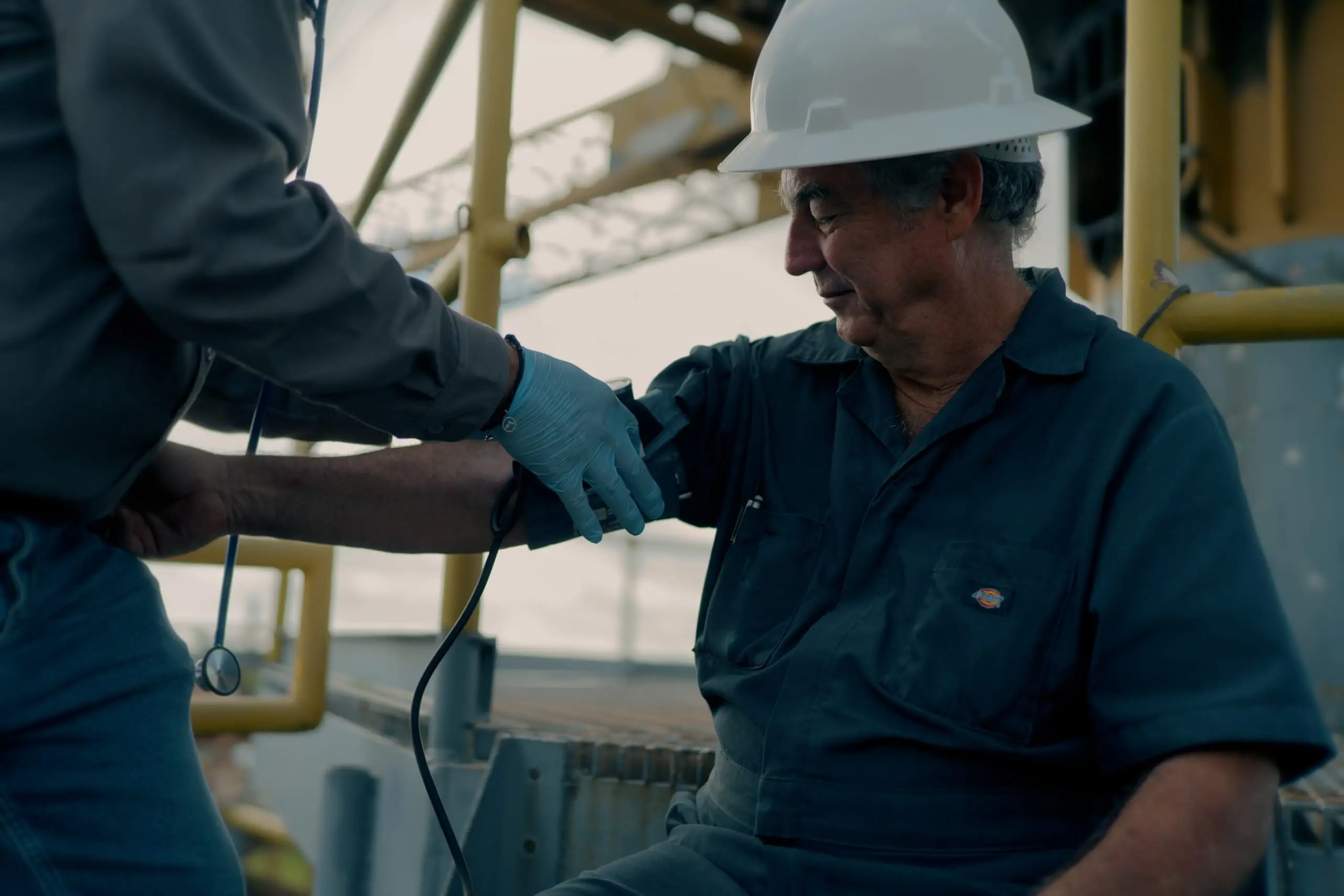
Offshore and remote industrial medics, paramedics, nurses, and advanced practitioners carrying ACLS, BLS, and PHTLS/ITLS, matched to your asset and scope of practice.

Offshore, nothing is in near proximity — every injury that leaves the deck becomes a helicopter, a reportable event, and a hole in your crew. On Site Medical & Safety places credentialed medics under 24/7 physician oversight so treatable cases stay treatable, and the ones that don't are already moving before the aircraft is called.
Offshore medical staffing for oil and gas operators is not a line item you defend to Finance — it is the control that keeps a laceration from becoming a flight, a flight from becoming a BSEE report, and a report from becoming an inspection finding.
Median U.S. charge for a single helicopter air-ambulance transport — up more than 60% since 2012.
Requires trained first-aid personnel and readily available supplies wherever no clinic or hospital is in near proximity. Offshore, nothing is.
Every injury requiring evacuation to shore or another facility is reportable to BSEE — each one a data point inspectors and prequalification networks can see.
Air-ambulance figures are national medians across all U.S. patients, published by the GAO from 2017 claims data — Gulf transports run longer distances than the national average. They are shown to size the exposure, not to quote a Gulf price.

No single rule says "put a paramedic on your platform." The obligation is assembled from several directions at once, and offshore is where they converge.
OSHA 29 CFR 1910.151(b) requires adequately trained first-aid personnel and readily available supplies wherever an infirmary, clinic, or hospital is not in near proximity. On a fixed platform ninety miles out, nothing is in near proximity. BSEE requires a SEMS program under 30 CFR 250 Subpart S, built on API RP 75, covering emergency response and evacuation with drills that are rehearsed and critiqued — and under 30 CFR 250.188, every injury requiring evacuation to shore or another facility is reportable. Vessel-side, the USCG and flag-state rules add their own manning and medical-care expectations.
Then there is the layer your customers impose. ISNetworld, Avetta, and Veriforce prequalification scores move on your recordable rate, and an unmanaged minor injury is the cheapest recordable there is. Staffing the asset is how you keep the case onboard, documented, and off the log.
Operators come to us for a single medic on a single asset and stay for the governance behind them. Both are available — the difference is how much of the program you want to stop managing yourself.
Offshore and remote industrial medics, paramedics, nurses, and advanced practitioners carrying ACLS, BLS, and PHTLS/ITLS, matched to your asset and scope of practice.
Topside Direct physician consultation behind every placement — treatment authorization, escalation, and the medevac call, so the medic on deck is never deciding alone.
Written, version-controlled standing orders and clinical protocols that define what your medic can treat, when they escalate, and what gets documented.
Licenses, certifications, and competencies tracked and current, with the file retrievable the day an auditor asks rather than the week after.
Where scope and POB allow, a single credentialed person covering both medical response and HSE duties — one seat, two functions, one bed.
Back-to-back coverage planned around your rotation, with relief arranged before a gap opens rather than after someone calls out.
Outfitting, restock triggers, expiration tracking, and controlled-drug chain of custody, so the position is not staffed into an empty cabinet.
Monthly clinical activity, fitness-for-duty status, and case-mix reporting through HealthLink — the numbers HSSE and leadership actually ask for.
The staffed position wired into your Medical Emergency Response Plan, evacuation pathways, and drill schedule instead of sitting outside them.
Mobilization timing depends on scope, location, credentialing, and equipment — but the sequence does not change.
Asset type, POB, rotation, distance to shore, existing sick bay, and what your client contracts already obligate you to.
Personnel matched to scope of practice and environment, with licenses, certifications, and site-specific requirements verified before travel.
Standing orders, escalation pathways, sick bay readiness, HealthLink records, and reporting cadence agreed and in place before day one.
Coverage runs on your rotation with physician oversight, monthly reporting, chart review, and quarterly governance reviews that adjust the program.
A credentialed medic working under standing orders and physician oversight treats onboard what would otherwise become a flight — and each avoided evacuation is one less reportable event.
Faster assessment on site, faster return-to-work determinations, and fewer crew rotated to shore for conditions that could have been managed at the asset.
Charts, protocols, credentials, and evacuation records complete and current, so BSEE inspections, client audits, and prequalification reviews are a retrieval task, not a reconstruction project.
Pricing is built per asset, not from a rate card. The variables are day rate and rotation pattern (14/14 and 21/21 are the common offshore schedules), scope of practice, whether the position is dual-role medic/HSE, and whether you want sick bay supply and physician oversight bundled in. The comparison that matters is not our day rate against another vendor's — it is the fully loaded program cost against a single unmanaged evacuation, which the GAO puts at a national median of roughly $36,400 for a helicopter transport before any downtime or reporting consequence. Send us the asset, crew size, and rotation and we will put a number in writing.
A credentialed medic on your rotation, backed by 24/7 topside physician consultation, written standing orders and clinical protocols, credentialing and competency tracking, electronic medical records through HealthLink, and monthly reporting on clinical activity and fitness status. Sick bay outfitting, restock, controlled-drug custody, Medical Emergency Response Planning, and occupational medicine can be added to the same contract or bought separately — most operators start with one position and add scope as the program proves out.
It depends on scope, location, credentialing requirements, and equipment readiness, and we will not quote a number before we know those. A straightforward replacement into an already-outfitted sick bay moves quickly because the bench and the credentialing file already exist. A new position on a new asset follows a structured mobilization covering scope definition, credentialing, sick bay readiness, protocol development, reporting setup, and testing. We tell you the realistic date on the scope call rather than the one you want to hear.
That is the point of the governance layer. Every case is charted, protocols and standing orders are written and version-controlled, credentialing and competency records are current and retrievable, and injuries requiring evacuation are documented to support your 30 CFR 250.188 reporting obligation. The same records feed ISNetworld, Avetta, and Veriforce prequalification and any client-specific audit, so you are not reconstructing a year of activity the week before someone arrives.
Yes. Campaign, turnaround, drilling, and construction-phase coverage are normal scopes — the crew is only offshore for the duration, and the medical coverage should track that. Short-duration coverage carries the same clinical governance, physician oversight, and documentation standard as a permanent position, because a compressed schedule with a swollen headcount is exactly when incident rates climb.
Yes. On Site has supported remote and offshore operations since 1998 from its Lafayette, Louisiana base, and the model travels — offshore platforms and vessels, pipeline and midstream, refinery and petrochemical, industrial construction, and remote land sites. The Gulf of Mexico is where we are densest, so mobilization there is fastest.